Artists
Edward Bawden (1903-1989)
Biography
Edward Bawden (1903–1989) was a distinctive British artist, illustrator, and designer whose work is celebrated for its wit, clarity, and inventive use of pattern. Associated with the interwar and postwar revival of graphic art in Britain, Bawden developed a highly individual style that combined modernist simplicity with a deep affection for English landscape, folklore, and everyday life.
Born in Braintree, Essex, Bawden studied at the Cambridge School of Art before enrolling at the Royal College of Art in London in 1922. There he formed important friendships with fellow artists Eric Ravilious and Enid Marx, connections that would shape his artistic outlook and place him within a loosely affiliated group often linked to British Modernism. While influenced by contemporary European design and typography, Bawden’s work remained rooted in local observation and narrative detail.
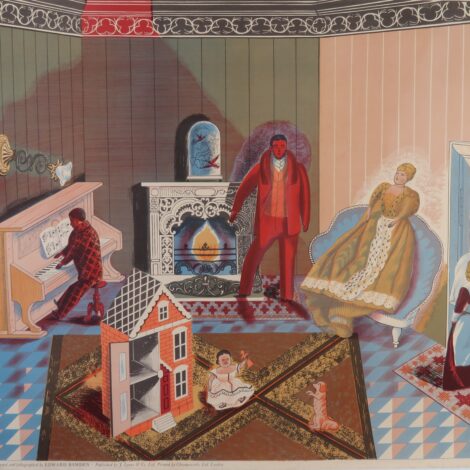
Bawden worked fluently across many media, including painting, illustration, graphic design, ceramics, and, most famously, linocut printing. His linocuts are particularly admired for their crisp lines, decorative textures, and subtle humour. He frequently depicted architectural scenes, rural settings, gardens, and travel subjects, rendering them with a balance of formal structure and playful detail. His colour sense—often bold yet restrained—became a defining feature of his work.
During the 1930s, Bawden established a successful career as a commercial artist. He produced book illustrations, wallpapers, posters, and advertisements, including work for London Transport and Fortnum & Mason. Despite working in commercial contexts, he maintainted a handcrafted feel that distinguished his designs from other contemporary graphic artists.
In World War II, Bawden served as an official war artist, documenting life in Britain and the Middle East. His wartime work combined reportage with irony, capturing both the absurdities and hardships of conflict without overt drama. After the war, he continued to travel widely, producing acclaimed series of prints inspired by Italy, North Africa, and the British countryside.
Later in life, Bawden returned to Essex, where he lived and worked until his death in 1989. Although sometimes overshadowed by contemporaries during his lifetime, his reputation has grown steadily and today he is one of the most admired and popular of Modern British artists, admired for his ability to unite modern design with warmth, humour, and a distinctly English sensibility.