
Prints for the People
2nd September 2026
The story of some mid 20th-century lithographs from the School Prints and similar series

John Nash: Window Plants
School Prints (1946)
In the years following World War II, there was a growing appetite for culture in Britain, and projects which promoted its accessibility. Penguin paperbacks were launched, meaning that everyone could have literature in their pocket, and the BBC’s Third Programme brought classical music to the masses.
In the world of art, there were several series which had similar aims: in the 1940s and 1950s, the Contemporary Lithographs, the School Prints, Lyons Lithographs, Coronation Suite and other schemes produced works by some of the foremost artists of the day and printed them in large numbers, making them affordable to much of the population.

L S Lowry: Punch and Judy
School Prints (1946)
One of the best-known projects was the School Prints, which published 36 prints in 3 series between 1946 and 1949. Led by the indomitable Brenda Rawnsley, the School Prints commissioned artists (including several who had been official War Artists) to produce work suitable for primary school age children. Mostly colourful and full of details to keep the young viewers engaged, themes ranged from circus to farms and outdoor activities, ballet, animals and townscapes. The artists included John Nash, Edwin LaDell, LS Lowry, Julian Trevelyan and Barbara Jones.

Tom Gentleman: Grey Horses
School Prints (1946)
Schools took out a subscription and received a new print regularly. The first two series (24 prints) were a great success, so Brenda Rawnsley decided to expand her remit and persuaded European artists including Picasso, Dufy and Matisse to produce work. These proved to be less popular – many considered too contemporary – and the project ran out of steam.
This meant that the edition size for the last series were smaller (probably 500 copies); these are now far more collectable
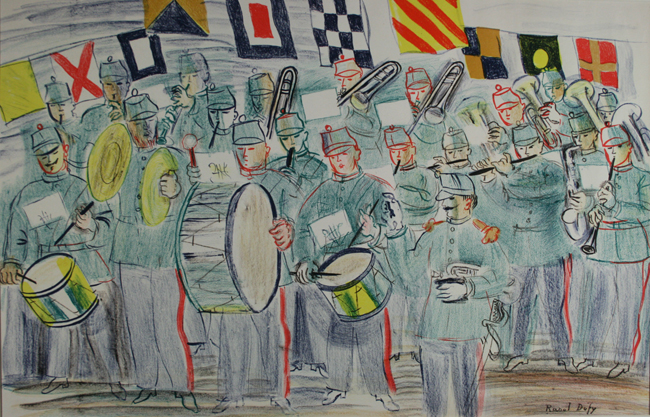
Raoul Dufy: The Band
School Prints – European series (1949)
Some years earlier, before the War, an innovative series of lithographs had been issued by the Council for the Encouragement of Music and the Arts (a forerunner of the Arts Council) – the CEMA prints. These were large prints, intended to be displayed “where War workers congregate”, in factory canteens and similar places. Their generally nostalgic feel was presumably supposed to encourage everyone that things would soon, surely, get better. Maybe even as before.

Harold Williamson: September – Hop Picking
Businesses were aware of, and interested in, these innovations in popular art. The Lyons Corner Teashops, a great fixture of 1950s British life, found themselves looking a little drab, post War. With paint hard to come by, an alternative was to cover the walls with large, inviting prints. So they were commissioned. The artists were (like the School Prints) those whose worked crossed over commercial graphic art (like the Shell posters) and fine art. These proved so popular with the customers that they wanted to take them home.
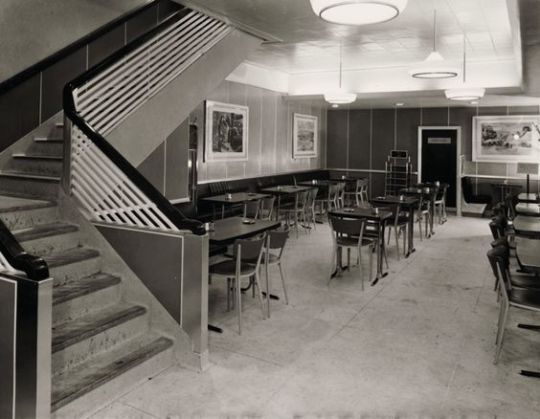
Interior of Lyons Tea Shop, c.1951, showing some of the lithographs
Lyons published two series of prints between 1946 and 1951, including iconic images such as Barnett Freedman’s “People” and Anthony Gross’s lithograph of cricket on Kew Green. A third series was issued in 1955. The full collection of 40 prints was displayed in an exhibition, opened by Sir Kenneth Clarke, at the Tea Centre in London. Such was their popularity that the prints were offered for sale at 12/6d for the smaller size and 17/6d for the larger ones. Though multiple numbers were sold, few have survived and are now avidly collected.

Edward Ardizzone: The Railway Station
For images of prints available and further details, click here